

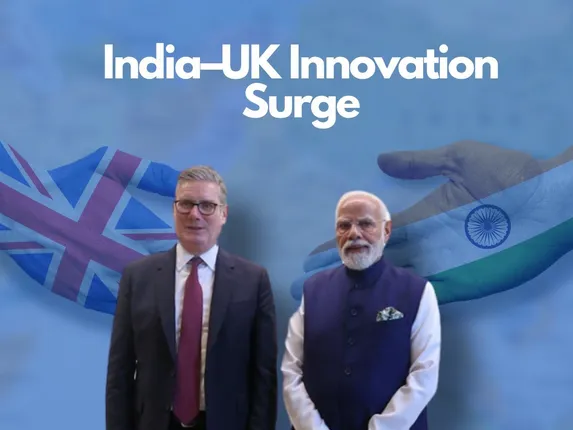
UK-India Emerging Tech Partnership Enters a New Era of Strategic Innovation
As the global race to dominate artificial intelligence, quantum computing, biotechnology and digital infrastructure accelerates, international collaboration is becoming more important than ever. Rather than competing in isolation, countries are increasingly realizing that innovation thrives through partnerships that combine talent, research, investment and real-world implementation.
Against this backdrop, the United Kingdom and India are strengthening their strategic partnership in emerging technologies, creating one of the most significant international collaborations of 2026. The growing alliance is expected to shape future breakthroughs in artificial intelligence (AI), quantum technologies, healthcare innovation, digital public infrastructure, cybersecurity, advanced manufacturing and scientific research.UK-
Experts believe that the partnership extends far beyond diplomatic relations. It represents a long-term commitment to building innovation ecosystems capable of addressing some of the world’s biggest challenges—from healthcare accessibility and climate resilience to responsible AI governance and quantum computing.
The renewed focus on collaboration comes at a time when both countries are investing heavily in research, higher education, startup ecosystems and advanced technologies that could define the global economy over the next decade.
Why Emerging Technology Partnerships Matter More Than Ever
Technology leadership is no longer determined solely by financial investment or domestic innovation.
Instead, future leadership depends on the ability to connect:
- world-class research institutions
- startup ecosystems
- skilled talent
- venture capital
- public policy
- industrial manufacturing
- digital infrastructure
Countries capable of integrating these elements through international collaboration are expected to lead the next technological revolution.
Artificial Intelligence, quantum computing, semiconductor manufacturing, biotechnology and digital health require enormous financial resources, multidisciplinary expertise and international standards.
No single nation possesses every competitive advantage.
This is precisely why the UK–India partnership has attracted global attention.
India’s Rising Position in Global Technology
Over the past decade, India has transformed into one of the world’s fastest-growing digital economies.
Several factors have strengthened India’s position:
- Massive software engineering workforce
- Rapid startup growth
- Affordable innovation ecosystem
- Expanding semiconductor ambitions
- Strong digital public infrastructure
- Government-backed innovation missions
India now hosts one of the world’s largest startup ecosystems with thousands of AI, fintech, health-tech and deep-tech companies.
Government initiatives such as:
- Digital India
- Startup India
- National Quantum Mission
- IndiaAI Mission
- Ayushman Bharat Digital Mission
- Digital Public Infrastructure (DPI)
have accelerated technology adoption across sectors.
Unlike many developed economies where innovation often begins inside research laboratories, India has demonstrated an exceptional ability to deploy technology rapidly at national scale.
Digital payments, Aadhaar identity systems and healthcare platforms are frequently cited as successful examples of large-scale digital transformation.
The UK’s Global Leadership in Research and Innovation
While India provides scale and implementation capability, the United Kingdom contributes decades of research excellence.
British universities consistently rank among the world’s leading institutions across:
- Artificial Intelligence
- Computer Science
- Biomedical Engineering
- Robotics
- Quantum Computing
- Medical Research
- Data Science
- Climate Technologies
Universities such as:
- University College London (UCL)
- University of Oxford
- University of Cambridge
- Imperial College London
have become global hubs for scientific innovation.
The UK also maintains one of Europe’s strongest venture capital ecosystems supporting deep technology startups.
This combination of academic excellence and commercial innovation makes the UK an ideal partner for India’s rapidly expanding technology ambitions.
AI Collaboration Could Transform Multiple Industries
Artificial Intelligence remains the centerpiece of UK-India cooperation.
Both countries recognize that AI will reshape:
- healthcare
- education
- transportation
- finance
- agriculture
- manufacturing
- governance
- defense
Joint AI research programs could focus on:
Healthcare AI
Developing diagnostic tools capable of identifying diseases earlier using machine learning.
Examples include:
- cancer detection
- diabetic retinopathy screening
- tuberculosis diagnosis
- personalized medicine
Education Technology
AI-powered learning platforms can personalize education according to each student’s learning pace.
India’s enormous student population offers one of the world’s largest testing grounds for educational AI.
Public Services
AI can improve:
- document verification
- citizen services
- traffic management
- taxation
- disaster response
Agriculture
Machine learning models can help farmers predict:
- crop diseases
- weather changes
- irrigation needs
- fertilizer optimization
Healthcare Innovation Takes Center Stage
Healthcare collaboration has become one of the strongest pillars of the UK-India partnership.
Universities, hospitals and private companies are working together on innovations that are:
- affordable
- scalable
- accessible
- technologically advanced
Some areas of collaboration include:
Early Disease Detection
AI-powered diagnostic tools may improve detection of:
- breast cancer
- cardiovascular disease
- diabetes
- neurological disorders
particularly in underserved rural communities.
Affordable Medical Devices
Researchers are designing portable diagnostic equipment suitable for regions with limited medical infrastructure.
Examples include:
- handheld ultrasound devices
- low-cost ECG systems
- smartphone diagnostic tools
Digital Health Records
Cloud-based healthcare platforms can improve:
- patient management
- medical history tracking
- telemedicine
- emergency response
Quantum Computing Becomes a Shared Priority
Quantum computing has emerged as one of the most strategic technologies of the next decade.
Unlike classical computers, quantum systems promise enormous computational power capable of solving previously impossible problems.
Potential applications include:
- drug discovery
- financial modelling
- logistics optimization
- advanced cybersecurity
- climate simulations
- materials science
India launched its National Quantum Mission to accelerate domestic capabilities.
Meanwhile, the UK has invested billions into quantum research through universities and innovation clusters.
Joint research could significantly reduce development timelines.
Interesting Reads
UK-India emerging tech partnership: Why it matters in 2026?
Can Humanities Graduates Find Better Career Opportunities in India?
Universities Are Driving the Partnership
Higher education institutions remain at the center of UK-India collaboration.
Universities serve as bridges connecting:
- researchers
- governments
- startups
- investors
- industry leaders
Joint initiatives increasingly include:
- dual degree programs
- faculty exchanges
- collaborative PhD research
- innovation incubators
- technology transfer programs
These initiatives not only produce research but also cultivate globally connected talent.
Building Future Technology Talent
One of the most valuable outcomes of international collaboration is human capital.
Students participating in exchange programs gain:
- global exposure
- research experience
- cross-cultural collaboration skills
- entrepreneurial thinking
Graduates often become future:
- startup founders
- researchers
- policymakers
- technology executives
The movement of skilled professionals between India and the UK creates long-term innovation networks that continue long after academic programs conclude.
Startups Could Become the Biggest Beneficiaries
India’s startup ecosystem and Britain’s venture capital market create significant opportunities.
Deep-tech startups working on:
- AI
- robotics
- cybersecurity
- biotechnology
- semiconductor design
could gain access to:
- international funding
- advanced laboratories
- global customers
- research partnerships
Similarly, British startups can leverage India’s engineering talent and market scale.
Responsible AI and Global Technology Governance
Beyond innovation, both countries increasingly recognize the importance of ethical technology development.
Key areas include:
- AI transparency
- algorithm accountability
- data privacy
- cybersecurity
- digital rights
- AI safety standards
The UK has played an important role in global AI safety discussions.
India, meanwhile, is developing regulatory frameworks focused on responsible innovation while encouraging technological growth.
Shared governance standards could influence international policy.
Challenges That Must Be Addressed
Despite growing optimism, several challenges remain.
Funding
Long-term research requires sustained financial investment.
Talent Mobility
Simplifying visa processes for:
- researchers
- scientists
- students
- entrepreneurs
will strengthen collaboration.
Intellectual Property
Clear IP frameworks are essential for encouraging joint innovation.
Regulatory Alignment
Technology regulations should be compatible enough to enable cross-border research without compromising national interests.
Infrastructure
Shared laboratories, cloud computing resources and advanced testing facilities remain crucial.
Why This Partnership Matters Globally
The UK-India technology partnership is not merely bilateral.
Its outcomes could influence:
- global AI standards
- healthcare innovation
- semiconductor supply chains
- cybersecurity cooperation
- climate technologies
- digital public infrastructure
Rather than viewing technology as a zero-sum competition, the collaboration demonstrates how nations can combine complementary strengths to accelerate innovation.
Economic Impact Could Reach Billions
Emerging technologies are expected to contribute trillions of dollars to the global economy over the coming decades.
The partnership could generate benefits including:
- increased foreign investment
- technology exports
- startup growth
- research commercialization
- high-skilled employment
- stronger digital economies
Businesses in both countries may gain access to new markets while consumers benefit from improved technological solutions.
The Road Ahead
Experts believe the success of the UK-India emerging technology partnership will depend on sustained commitment rather than isolated projects.
Future priorities are expected to include:
- Expanding AI research collaborations
- Strengthening quantum computing initiatives
- Increasing healthcare technology partnerships
- Supporting startup innovation
- Enhancing cybersecurity cooperation
- Facilitating researcher mobility
- Building next-generation semiconductor capabilities
- Promoting responsible AI governance
If these goals are pursued consistently, the partnership could become one of the defining technology alliances of the decade.
Conclusion
The UK-India Emerging Tech Partnership reflects a broader shift in how technological leadership is being shaped in the twenty-first century. Rather than relying solely on domestic capabilities, nations are increasingly recognizing the value of collaborative innovation that combines complementary strengths. India’s rapidly expanding digital ecosystem, engineering talent and large-scale technology deployment capabilities complement the United Kingdom’s globally respected research institutions, innovation clusters and scientific expertise.
From artificial intelligence and quantum computing to healthcare innovation, digital public infrastructure and responsible AI governance, the partnership offers significant opportunities for both countries to address shared challenges while accelerating technological progress. Universities, startups, policymakers and industry leaders are expected to play a central role in translating research into practical solutions that benefit society.
As global competition in emerging technologies intensifies, the UK and India have an opportunity to demonstrate that cooperation can be just as powerful as competition. With sustained investment, supportive policies and continued knowledge exchange, this strategic alliance has the potential to influence not only bilateral growth but also the future direction of global technology innovation.
