

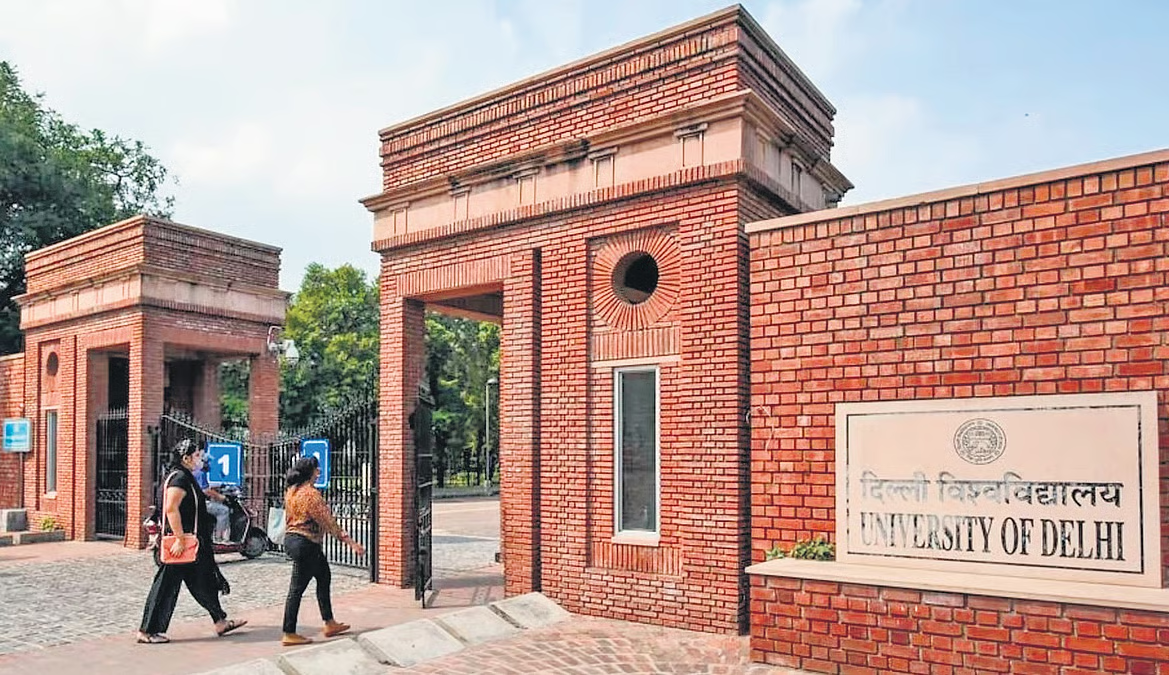
Humanities Graduates Left Behind? DU History Student’s Placement Experience Sparks Debate on India’s Hiring System
A recent LinkedIn post detailing the placement struggles of a Delhi University History graduate has reignited a nationwide debate over employment opportunities for humanities students in India. The post, which quickly gained traction on social media, highlighted the challenges faced by students pursuing non-technical degrees despite strong academic achievements.
The story has struck a chord with thousands of students, educators, recruiters, and professionals who argue that India’s campus recruitment ecosystem continues to favour engineering, management, and commerce graduates while offering limited opportunities to students from humanities and social science backgrounds.
At the centre of the discussion is a graduate who reportedly completed a Bachelor of Arts (Honours) in History from Delhi University with an impressive 84% score and a place on the Dean’s List. Despite her academic excellence, she was allegedly informed by her college placement cell that there were no companies visiting the campus to recruit humanities students.
The incident has sparked broader conversations about whether India’s recruitment system adequately recognises critical thinking, communication, research, and analytical skills—qualities often associated with humanities education.
The Story That Triggered the Debate
The discussion began after entrepreneur and founder Harshit Khare shared the experience of his friend through a LinkedIn post.
According to Khare, his friend excelled academically throughout her undergraduate studies. She consistently demonstrated strong writing abilities, analytical thinking, and the capacity to engage in complex discussions on subjects such as colonial economics, history, and public policy.
However, when she approached the placement office hoping to secure employment through campus recruitment, she allegedly received a disappointing response.
The placement cell reportedly informed her that there were no companies participating in recruitment specifically for humanities students.
What made the experience more discouraging, according to the post, was the absence of alternative support. There were reportedly no specialised placement drives, career counselling sessions, internship recommendations, or employer connections offered to help students from arts backgrounds transition into the workforce.
Instead, the graduate was left to navigate the job market independently.
Months of Job Searching and Career Uncertainty
The LinkedIn post further described how the graduate spent nearly eight months applying for jobs through online portals, networking platforms, and cold emails.
Despite receiving interview opportunities, she frequently encountered a common challenge faced by many humanities graduates—being considered “not qualified on paper.”
Several recruiters reportedly prioritised candidates with technical degrees or business qualifications, even for roles where communication, research, writing, and analytical thinking formed significant parts of the job description.
Eventually, after months of searching, she secured a content writing position at a startup with a monthly salary of approximately ₹12,000.
Khare argued that the outcome reflected not a lack of talent or ability but rather structural shortcomings in India’s placement ecosystem.
According to him, the system often predetermines career outcomes based primarily on degree categories instead of evaluating actual skills and potential.
A Larger Question About India’s Placement Infrastructure
The incident has prompted wider discussions about how placement cells function across universities.
In many engineering colleges and management institutes, campus recruitment is a well-established process involving hundreds of companies conducting interviews every year.
Students often receive placement training, aptitude preparation, mock interviews, resume-building workshops, and direct access to recruiters before graduation.
However, many arts and humanities colleges reportedly experience a very different reality.
Placement opportunities are frequently limited, employer participation remains comparatively low, and students often rely on off-campus applications to begin their careers.
Education experts say this gap has existed for years but has become increasingly visible as employers continue emphasising soft skills, creativity, communication, and problem-solving—qualities commonly nurtured through humanities education.
Do Employers Really Value Soft Skills?
One of the strongest arguments raised in the LinkedIn post questions an apparent contradiction in corporate hiring practices.
Modern organisations frequently claim to value attributes such as:
- Critical thinking
- Communication skills
- Creativity
- Emotional intelligence
- Research capability
- Adaptability
- Writing proficiency
- Leadership potential
Ironically, these are precisely the competencies that many humanities programmes seek to develop through essays, debates, presentations, research projects, literature analysis, historical interpretation, and interdisciplinary learning.
Yet campus hiring patterns continue to favour candidates from engineering, management, computer science, and commerce backgrounds.
This disconnect has led many professionals to question whether recruitment systems truly assess skills or continue relying heavily on degree labels as initial screening criteria.
Humanities Education: More Relevant Than Ever?
Supporters of humanities education argue that today’s rapidly changing economy actually requires many of the abilities cultivated through arts and social science disciplines.
As artificial intelligence automates repetitive technical tasks, employers increasingly need professionals who can understand human behaviour, communicate effectively, solve complex social problems, and make ethical decisions.
Fields such as:
- Public policy
- Journalism
- Content strategy
- User experience research
- Digital marketing
- Corporate communications
- Human resources
- International relations
- Consulting
- Education technology
- Social impact organisations
all depend heavily on strong communication and analytical skills.
Experts therefore argue that humanities graduates possess valuable capabilities that remain underutilised due to outdated recruitment practices rather than limitations in their education.
The Growing Importance of Skills Over Degrees
The debate also reflects a broader transformation taking place across global employment markets.
Many leading technology companies have gradually shifted towards skills-based hiring instead of focusing exclusively on academic qualifications.
Recruiters increasingly evaluate candidates based on portfolios, internships, certifications, practical projects, communication ability, and problem-solving skills rather than degree titles alone.
Online learning platforms have further accelerated this shift by allowing learners from diverse academic backgrounds to acquire specialised knowledge in areas such as data analytics, digital marketing, UX design, project management, artificial intelligence, and business analytics.
As a result, many experts believe the future job market may place greater emphasis on demonstrated competencies than traditional academic streams.
Social Media Reactions Highlight a Divided Opinion
Following the viral LinkedIn post, social media platforms were flooded with reactions from students, professionals, recruiters, and educators. While many empathised with the Delhi University graduate’s experience, others argued that the issue is more nuanced than simply blaming placement systems.
Several humanities graduates shared similar stories of struggling to find campus opportunities despite excelling academically. Many said they had to spend months applying independently before securing their first jobs, often accepting lower salaries than their counterparts from technical disciplines.
One user remarked that the irony lies in today’s workplace demands. Companies frequently talk about innovation, communication, leadership, and creative thinking, yet recruitment processes continue to prioritise conventional degree backgrounds.
Another professional pointed out that artificial intelligence is rapidly changing the employment landscape. As routine coding and repetitive technical tasks become increasingly automated, organisations may begin placing greater importance on employees who can think critically, understand human behaviour, communicate effectively, and solve complex business problems—areas where humanities graduates often excel.
However, not everyone agreed with the criticism of placement systems.
Some professionals argued that recruitment decisions are based on business requirements rather than academic streams. They maintained that employers seek candidates whose education aligns closely with specific job responsibilities and that a History degree may not naturally fit every corporate role.
Others suggested that students should proactively develop industry-relevant skills alongside their degrees rather than relying solely on campus placements.
The discussion reflects a larger national conversation about whether India’s higher education system is adequately preparing graduates for an evolving employment market.
The Employability Challenge Beyond Engineering
The debate surrounding the DU graduate’s experience highlights a broader issue affecting higher education in India—the employability gap.
For decades, engineering and management programmes have dominated campus recruitment, benefiting from established relationships between institutions and industry. Humanities departments, despite producing graduates with strong analytical and communication abilities, often receive comparatively limited employer engagement.
Education experts believe this disparity stems from several factors:
- Limited corporate outreach to arts and humanities departments.
- Lack of structured internship opportunities during undergraduate studies.
- Lower awareness among recruiters about transferable humanities skills.
- Placement cells focusing primarily on technical and professional programmes.
- Students receiving limited career guidance beyond traditional professions such as teaching or civil services.
As industries diversify and new career paths emerge, experts argue that universities must rethink how they prepare humanities students for employment.
Interesting Reads
How School Leaders Can Successfully Bring AI into Education: A Practical Guide for Principals
Expanding Career Opportunities for Humanities Graduates
Contrary to popular perception, humanities graduates today have access to a wide range of career opportunities across both traditional and emerging sectors.
Graduates with strong writing, research, analytical, and communication skills are increasingly finding roles in:
- Content Strategy and Digital Media
- Journalism and Broadcasting
- Public Relations and Corporate Communications
- Policy Research and Think Tanks
- Civil Services and Government Administration
- International Development Organisations
- Human Resources and Talent Management
- User Experience (UX) Research
- Advertising and Brand Strategy
- Market Research and Consumer Insights
- Publishing and Editing
- Education Technology
- Social Impact and Non-Governmental Organisations
- Consulting and Knowledge Services
- Digital Marketing and Content Creation
The rapid expansion of India’s startup ecosystem has also opened opportunities for graduates who possess creativity, adaptability, storytelling abilities, and problem-solving skills.
Industry leaders increasingly recognise that successful organisations require multidisciplinary teams where technical expertise is complemented by strong communication and strategic thinking.
Can Universities Bridge the Gap?
Many education specialists believe universities have an important role in improving employment outcomes for humanities students.
Possible reforms include:
- Building stronger partnerships with startups, media companies, consulting firms, research organisations, and NGOs.
- Offering mandatory internships as part of humanities curricula.
- Organising career fairs specifically designed for liberal arts and social science students.
- Providing professional certification programmes alongside degree courses.
- Conducting workshops on resume building, interview preparation, networking, and digital skills.
- Inviting alumni working across diverse industries to mentor current students.
Placement cells could also expand employer outreach beyond traditional recruiters by engaging companies that actively seek candidates with communication, research, policy analysis, and content development expertise.
Such initiatives could significantly improve career visibility for humanities graduates while helping employers discover untapped talent.
A Changing Job Market Requires a New Mindset
India’s employment landscape is evolving rapidly under the influence of artificial intelligence, automation, digital transformation, and the knowledge economy.
Increasingly, employers are seeking professionals who combine technical understanding with creativity, ethical reasoning, collaboration, and communication.
This shift presents an opportunity to rethink long-standing assumptions about the value of different academic disciplines.
Rather than viewing engineering, commerce, and humanities as competing streams, experts suggest that the future workforce will benefit from interdisciplinary learning, where technical knowledge is complemented by social sciences, behavioural understanding, economics, history, psychology, and communication.
Several leading global universities have already embraced such models by encouraging students to combine engineering with philosophy, computer science with psychology, or economics with political science.
Conclusion
The story of the Delhi University History graduate has resonated because it reflects concerns shared by countless students across India’s higher education system. Whether or not every employer can recruit from every academic discipline, the conversation has highlighted the need for a more inclusive placement ecosystem that recognises skills alongside degrees.
Academic excellence, critical thinking, communication, and research capabilities remain valuable assets in today’s knowledge-driven economy. Yet many humanities graduates continue to face limited visibility during campus recruitment, often forcing them to compete in the job market without institutional support.
As industries evolve and employers increasingly emphasise creativity, adaptability, and human-centric problem-solving, universities and recruiters alike may need to revisit traditional hiring practices. Strengthening partnerships between academia and industry, expanding career pathways for humanities students, and adopting skills-based recruitment models could help bridge the existing gap.
The debate ultimately extends beyond one student’s experience. It raises a fundamental question for India’s education system: Can higher education institutions ensure that talent is recognised not by the title of a degree alone, but by the abilities graduates bring to the workplace? The answer to that question could shape the future of employability for millions of students across disciplines.
